

Why Businesses Choose to Buy Ceramic Band Heaters for Superior Industrial Heating

Introduction
Industrial heating plays an important role in maintaining production quality, equipment performance, and operational efficiency. In industries such as plastics processing, injection molding, extrusion, packaging, and manufacturing, even small variations in temperature can affect the final product. This is why businesses increasingly look for heating solutions that provide consistent heat, dependable performance, and long service life.
Ceramic band heaters have become a popular choice for applications that require efficient and controlled cylindrical heating. Designed to fit around barrels, pipes, nozzles, and other industrial components, these heaters transfer heat effectively while supporting precise temperature control. For companies searching for a dependable heating solution, understanding the benefits of ceramic technology can make the purchasing decision much easier.
What Are Ceramic Band Heaters?
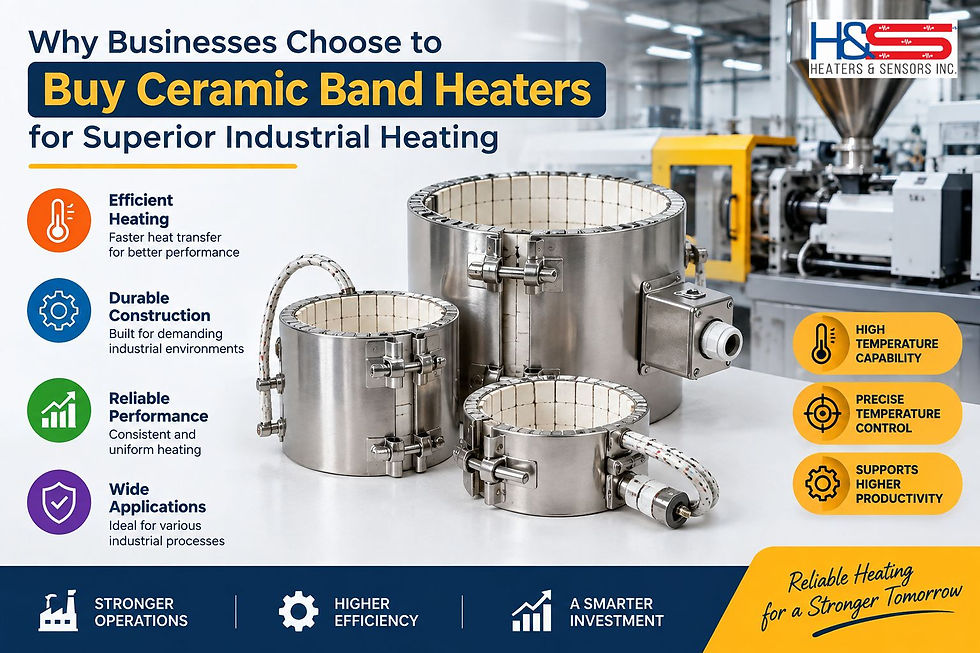
Ceramic band heaters are electrical heating devices designed in a circular or band-shaped configuration. They are typically installed around cylindrical components where uniform surface heating is required.
Unlike conventional heating systems, ceramic band heaters use ceramic heating elements that can operate at relatively high temperatures while providing efficient heat transfer. Their construction also allows them to withstand demanding industrial environments.
When businesses buy ceramic band heater solutions, they often select them for equipment such as:
Plastic injection molding machines
Extrusion machinery
Blow molding equipment
Processing barrels
Industrial pipes and tanks
Dies, nozzles, and similar cylindrical components
The exact heater design depends on the equipment, operating temperature, dimensions, voltage, wattage, and application requirements.
Why Businesses Prefer Ceramic Band Heaters
1. Efficient Heat Transfer
One of the major advantages of ceramic band heaters is their ability to transfer heat efficiently to the surface of the equipment. Ceramic insulation and heating elements help minimize unnecessary heat loss, allowing more of the generated heat to reach the target component.
Improved heat transfer can help industrial operations maintain desired temperatures while potentially reducing energy waste. For businesses running heating equipment for extended periods, this efficiency can be particularly valuable.
2. High-Temperature Performance
Many industrial processes require temperatures that ordinary heating solutions may struggle to maintain consistently. Ceramic band heaters are designed for applications involving demanding temperature conditions.
Their ceramic construction provides thermal stability and makes them suitable for equipment operating at elevated temperatures. However, the appropriate heater should always be selected according to the manufacturer's temperature rating and the specific application.
3. Uniform Heating
Temperature consistency is critical in manufacturing. Uneven heating can result in inconsistent material flow, poor product quality, equipment problems, or unnecessary production waste.
Ceramic band heaters are designed to provide relatively uniform heating around cylindrical surfaces. Proper sizing, installation, and temperature control can help businesses maintain stable operating conditions throughout the production process.
Better Temperature Control
Modern manufacturing depends heavily on accurate temperature management. A heating system that frequently fluctuates can negatively affect production consistency.
When companies buy ceramic band heater products that are correctly matched to their equipment, they can integrate them with thermostats, temperature controllers, thermocouples, or other monitoring systems. This allows operators to maintain the required operating temperature more effectively.
Better control can contribute to:
Consistent processing conditions
Improved product quality
Reduced overheating risks
More predictable production cycles
Better equipment performance
The heater itself is only one part of an effective temperature-control system. Proper sensors and controls are equally important.
Durability for Demanding Industrial Applications
Industrial equipment often operates for long hours under challenging conditions. Frequent heating and cooling cycles, vibration, moisture, and high operating temperatures can place considerable stress on heating components.
Ceramic band heaters are valued for their robust construction and ability to perform in demanding environments when properly specified and installed. Their durability can help reduce the frequency of heater replacement and minimize interruptions caused by heating-component failures.
For businesses considering whether to buy ceramic band heater products for long-term use, durability should be evaluated alongside electrical specifications, temperature requirements, dimensions, and overall equipment compatibility.
Choosing the Right Ceramic Band Heater
Selecting a heater should not be based on price alone. An incorrectly sized heater may deliver poor performance or create unnecessary operating problems.
Before purchasing, businesses should consider several important specifications:
Key Factors to Check
Diameter and width: The heater must fit the equipment correctly.
Voltage: The electrical rating should match the available power supply.
Wattage: Appropriate wattage is necessary to achieve the required heating performance.
Operating temperature: Select a heater rated for the intended working temperature.
Construction: Consider the operating environment and expected service conditions.
Connection type: Leads, terminals, and connection arrangements should suit the equipment.
Temperature control: Confirm compatibility with the required controller and sensor system.
Consulting a heating specialist before ordering can help prevent compatibility issues and ensure the heater is suitable for the intended application.
Applications Across Different Industries
Ceramic band heaters are used across a wide range of industrial processes. Their cylindrical design makes them particularly useful wherever controlled surface heating is required.
Common applications include plastic processing, extrusion, injection molding, packaging equipment, food-processing machinery, chemical processing systems, and various manufacturing operations.
For companies planning to buy ceramic band heater products for specialized machinery, customized dimensions and electrical configurations may also be available depending on the manufacturer and application.
Why Quality Matters
Industrial heating components directly influence production performance. A low-quality heater may result in inconsistent temperatures, premature failure, higher maintenance requirements, or unexpected downtime.
Choosing a reliable supplier is therefore an important part of the purchasing process. Businesses should look for suppliers that provide clear technical specifications, quality manufacturing, customization options where required, and knowledgeable support.
A good supplier should also be able to help customers determine the correct heater dimensions, wattage, voltage, and temperature rating based on their equipment.
Conclusion
Ceramic band heaters offer an efficient and practical heating solution for many industrial applications. Their high-temperature capability, heat-transfer efficiency, uniform heating, and durable construction make them a valuable option for businesses that depend on reliable temperature control.
Whether the requirement involves injection molding, extrusion, plastic processing, or specialized industrial machinery, selecting the right heating component can have a significant impact on production performance. Businesses looking to buy ceramic band heater products should carefully evaluate their equipment requirements and work with a knowledgeable supplier to identify the right specification.
With the correct heater, installation, and temperature-control system, manufacturers can create a more consistent, efficient, and dependable heating process—helping support better production results and long-term operational reliability.


Comments